
Electric Vehicle Articles and Historical Facts
Electric Vehicle Timeline & Historical Facts
The X Factor – Electric Vehicles (February 20. 2012)
Nikola Tesla – The True Genius and Father of Electricity (January. 2012)
The Future of Electric Vehicles for 2012 and beyond (January. 2012 - Mario Fragapane)
Electric Cars or Not? (February. 2011 - Mario Fragapane)
What ever happened to the EV1 electric car by GM?
Nissan Hypermini
Toyota Rav 4 Electric Series
Press Launch on the EV1 on release day
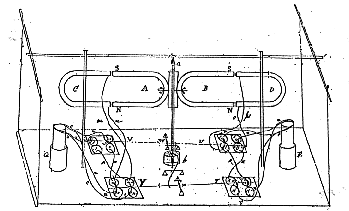
1834 Thomas Davenport & O. Smalley - Electromagnetic Engine Mitsubishi iMiev prototype Illustration of Davenport and Orange Smalley's electromagnetic engine as drawn by Turner in 1834 from Franklin Leonard Pope, "The Inventors of the Electric Motor-II., The Electrical Engineer 11 (14 January 1891): 35. Courtesy of Henry Paynter.
In December of 1833, Thomas Davenport purchased a large, battery-powered, electromagnet at the Penfield Iron Works at Crown Point, New York, where this newly developed invention was being used to separate iron ore. For the next several months, he and Orange Smalley worked together in Smalley's shop on experiments in electromagnetism. By the summer of 1834, they succeeded in producing rotary motion.
After refining the machine, Electric cars and vehicles are becoming more and more popular in today's culture. You no longer have to be a parts geek or engineer to design or build you own EV vehicle. As more companies continue to produce EV cars you will see even more acceptance of these vehicles by the general public.Davenport and Smalley demonstrated their "electromagnetic engine" to Professor Turner of Middlebury College at Middlebury, Vermont, in December of 1834. In a handwritten note of January 5, 1835, Professor Turner described "Davenport and Smalley's Specification of their Invention of an Electro-Magnetic Machine." His description of the invention was illustrated with the drawing shown above. You can read more on Thomas Davenport here.

1834 Thomas Davenport & O. Smalley - Electromagnetic Engine
Between 1832 and 1839 (the exact year is uncertain), Robert Anderson of Scotland invented the first crude electric carriage. Illustration of Davenport and Smalley's electromagnetic engine as drawn by Turner in 1834 from Franklin Leonard Pope, "The Inventors of the Electric Motor-II., The Electrical Engineer 11 (14 January 1891): 35. Courtesy of Henry Paynter. In December of 1833, Thomas Davenport purchased a large, battery-powered, electromagnet at the Penfield Iron Works at Crown Point, New York, where this newly developed invention was being used to separate iron ore. For the next several months, he and Orange Smalley worked together in Smalley's shop on experiments in electromagnetism.
By the summer of 1834, they succeeded in producing rotary motion. 1851 Charles B. Page Probably the most spectacular demonstration of electricity as motive power was achieved by Dr. Charles Grafton Page, who for many years occupied an important position at the Patent Office in Washington. In 1838 Page exhibited in London a locomotive propelled by battery power around a circular railway track.
As early as 1845 it had been observed by Morse's partner Alfred N. Vail that a hollow coil of wire possesses the curious property of sucking a soft iron core into its center with considerable force when an electric current is applied. Page saw this phenomenon demonstrated, and from it conceived the idea of using that force in an electric motor. In 1850, after numerous experiments, he constructed a machine that developed over 10 horsepower..
1852-1966 Studebaker
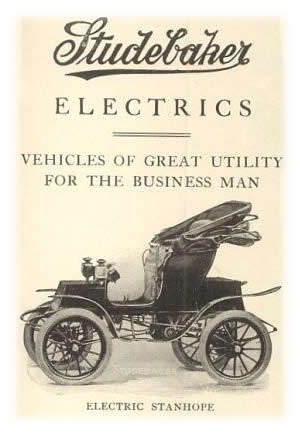
Studebaker produced its first salable automobile, an electric, in 1902. It entered the gasoline automobile business in 1904. In late 1910, Studebaker mergered with EMF Corp. to form Studebaker Corp. In 1915, the first non-family member, Albert R, Erskine, became president of the corporation. During this period, Studebakers was, except for Ford, amoung the largest producers of automobiles in the country. Sales increases continued at a steady clip until the stock market crash of 1929.
Erskine felt that the depression would be short lived, so he continued to distribute large dividends. Erskine's misjudgement led Studebaker into recievership in 1933.Two resourceful Studebaker executives, Paul G, Hoffman and Harold S, Vance, pulled things together and saved the company. Hoffman and Vance guided the company through the depression and introduced the successful Champion model. They were still directing the company in 1945, when automobile production resumed.
By the summer of 1834, they succeeded in producing rotary motion.Hoffman was president and Vance acted as Chairman of the board. Both men were responsible for Studebaker becoming the first established American automobile company to introduce a new postwar styling. A stlylish new car and a seller's market helped Studebaker establish new sales and profit records during the late 40's.
Although Studebaker's image seemed rosey, it was during this period that the seeds of the company's eventual undoing were taking root. A pampered work force and many outdated buildings resulted in poor productivity and high overhead. When the seller's market became the buyer's market, in the early 50's, these problems started to eat away at the profits. If the company had fed more profits back into plant improvements and taken a hard labor strike, things would have been much better. By 1953, the automobile division was operating in the red. Hoffman, who had left in 1948 to take a goverment position, returned in 1953. Neither him nor Vance could stop the flow of red ink.
Low slung new styling in 1953, a takeover by Packard in 1954, and help from Curtis-Wright in 1956, just prolonged what most insiders felt was a hopeless cause. The formation of Studebaker-Packard Corp. brought in James Nance as chief execustive officer. Two years later, under the guidance of Curtis-Wright, Harold Churchill was selected as Studebaker-Packard's new president. This was a wise choice. Churchill an engineer, was a loyal Studebaker man who had been with the corporation since 1926. He was determined to see to it that the company survived.
In late 1958 Churchill introduced the Lark. This first compact car proved to be a big success during it's first year. Chuchill wanted to use the 1959 profits to keep Studebaker in the forefront of small car development. However the board of directors prefered using most of the profits for diversification. This difference of opinon resulted in the early 1961 replacement of Churchill with Sherwood Egbert.
Low slung new styling in 1953, a takeover by Packard in 1954, and help from Curtis-Wright in 1956, just prolonged what most insiders felt was a hopeless cause. The formation of Studebaker-Packard Corp. brought in James Nance as chief execustive officer. Two years later, under the guidance of Curtis-Wright, Harold Churchill was selected as Studebaker-Packard's new president. This was a wise choice. Churchill an engineer, was a loyal Studebaker man who had been with the corporation since 1926. He was determined to see to it that the company survived.
Egbert working within the constrictions of the board, also hoped to save the automobile division. His efforts fostered the creation of the Gran Turismo Hawk and the Avanti. Egbert's achievements, although commendable, did not help Studebaker's position. It was again on the negitive side of the profit scale. The Packard name was dropped in 1962.
In late 1963, Egbert stepped down because of failing health. Studebakers directors voted to close down most of the South Bend, INd. facility. Production was then centralized at the Hamilton plant, in Ontario, Canada. President of the Hamilton divison was Gordon Grundy. He tried his best to operate the facility in the black. He did manage make small profits, but not enough to satisfy the board of directors. Because of the boards dissatisfaction, the Canadian plant was closed in March 1966. By early 1966, the corporation's other diversified holdings, including STP, represented a majority of Studebaker sales.
These other companies kept Studebaker going. In mid 1967, the Studebaker Corp. purchased the Wagner Electric Corp. and in November 1967 Studebaker combined with the Worthington Corp. to form Studebaker-Worthington. In the fall of 1979, the Studebaker-Worthington Corp. was absorbed by the smaller McGraw-Edison Co. of Illinois. Cooper Industries took over McGraw-Edison in 1985.
1881-1906 Jeantaud
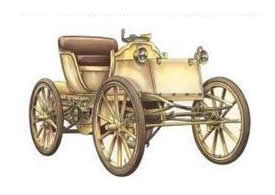
The Jeantaud was a French automobile manufactured in Paris from 1893 until 1906. It was the brainchild of Charles Jeantaud, a coachbuilder who built his first electric carriage in 1881.
Among the vehicles he constructed was the first car to set a land speed record (39.24 mph (63.15 km/h), driven by Gaston de Chasseloup-Laubat), as well as coupes and hansom cabs; in these the driver sat high, and to the rear.
Some cars had an unusual bevel-gear front-wheel-drive layout. From 1902 to 1904, Jeantaud offered a range of gas-engined cars similar to 1898 Panhards.
1899 La Jamais Contente
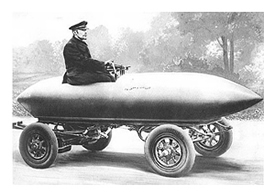
In 1899, the La Jamais Contentewas made by a man named Camille Jenatzy. This vehicle was the first car to go over 100 km/h (or about 62 mph). It was torpedo shaped, and made of super light and super expensive material no other car has ever been made out of.
Among the vehicles he constructed was the first car to set a land speed record (39.24 mph (63.15 km/h), driven by Gaston de Chasseloup-Laubat), as well as coupes and hansom cabs; in these the driver sat high, and to the rear.
Some cars had an unusual bevel-gear front-wheel-drive layout. From 1902 to 1904, Jeantaud offered a range of gas-engined cars similar to 1898 Panhards.
1888 Fred Kimball
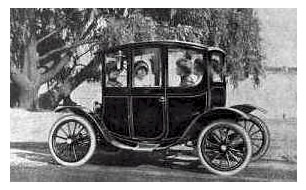
Philip W. Pratt demonstrates the very first American electric tricycle.
Pratt’s e-trike was built for him by Fred M. Kimball of, naturally, the Fred M. Kimball Company. Pratt took the editor of Modern Light and Heat for a spin around Winthrop Square (above) in Boston.
The vehicle’s 10 lead-acid cells pushed about 20 volts to a 0.5 horsepower DC motor. The whole setup weighed about 300 pounds.
The driver sat above the battery assemblage. Top speed: 8 miles an hour.
We don’t have any bystander accounts of that moment, but the mechanically propelled vehicle probably caused quite a scene.
The driver would have had to carefully navigate around horses and people to avoid sending them into a panic. In many locales, early automobilists had to stop their engines and pull over to let horses pass. The beasts regarded these new vehicles with intense suspicion and had the nasty habit of rearing and running in their presence.
William Morrison 1890
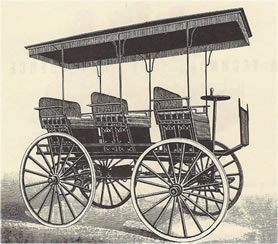
Born in Scotland Morrison arrived in Des Moines in 1880 as a chemist. In 1887 he made an unsuccessful attempt to build a car but the center-pivot steering didn't work.
He then commissioned a fringe top surrey from the Des Moines Buggy Company, that he electrified in September of 1890, to demonstrate his new battery (patented 1891 With L. Schmidt). It may have been the first land vehicle steered with a wheel, and featured his patented rack and pinion steering gear (Immisch may have done both a year earlier).
Watchmaker Dr. Lew Arntz did the mechanical modifications. Powered by 24 of his lead-acid storage cells (48 Volts) with 112 Ampere-hours capacity it weighed two tons. A spur gear on a four horse-power Siemens trolley-car motor, that Morrison rewound to work at a lower voltage more practical for battery application (about 15% of trolley car voltage), this drove a large ring gear on the right rear wheel. This car became very influential when the American Battery Company of Chicago purchased it for $3,600 to demonstrate their commercial version of the Morrison battery at the 1893 World's Columbian Exhibition. At the fair almost everyone who would be influential in early motoring history saw the carriage. ABC Secretary Harold Sturges replaced the rear seat with a larger battery, installed a different motor, and entered it in the Chicago race on Thanksgiving Day 1895. Due to five inches of fresh snow on the roads the car had little chance, the motor overheated in the first ten miles. The race version weighed 3,535 lbs. Major George Tyler Burroughs VP of ABC estimated that between Morrison and American Battery more than $20,000 had been invested in the car, all though he felt that production cost would be about $1,000 per car. The car was last seen in Kansas City MO. Morrison further developed batteries at the Vesta Accumulator Co., and in the summer of 1897 Sturges went to the Klondike to search for gold.
1895-1897 Morris & Salom
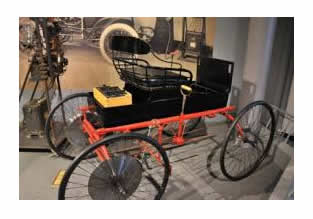
Morris & Salom, Philadelphia. Pedro Salom was a chemist and Henry Morris a mechanical engineer; they had backgrounds in battery streetcars and in 1894 (as the battery streetcar business was fading) teamed up to make battery road vehicles. The first Electrobat was a slow, heavy, impractical vehicle. Morris & Salom went on to build about a dozen Hansom cabs based on the Electrobat before selling the concept and the cabs to Isaac Rice of Electric Storage Battery (see Electric Carriage & Wagon Co).
ype I 1894; 4,250 lbs with a 1,600 lb battery. Said to go 50 miles at up to 15 mph. It had steel tires to support the weight. Built like a small version of a battery streetcar.
Type II 1895; this vastly improved vehicle weighed 1,650 lbs. with a 640 lb battery. With two 1 1/2 hp motors, pneumatic tires, 25 miles per charge at 20 MPH. The body was designed and built at the Charles S Caffery Carriage Co, across the river in Camden New Jersey, (with the help of Walter C Baker's bearings and axles). They steered by the rear wheels.
Type III no info.
Type IV Late 1895; 800 lbs with a 350 lb battery, two 75 lb motors, 15 mph for 20-25 miles.
Moritz Immisch 1894
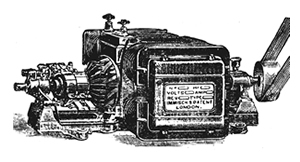
Immisch & Company built a four-passenger carriage, powered by a one-horsepower motor and 24-cell battery, for the Sultan of the Ottoman Empire. In the same year, Magnus Volk in Brighton, England made a three-wheeled electric car.
Originally he had started by making his name among the chief watch and clock manufacturers, and in 1872 had won the baroness Burdett-Coutts's prize for a thesis on the isochronism of the balance spring. Entitled "The Balance Spring" the thesis was subsequently published in book form. Moritz Immisch's talented mind, however, was neither fully occupied nor stretched in this limited work. Like others with great skill in instrument making, he became enthused by the opportunities presented by the new discoveries in electricity. It was thus his experiments in electricity, magnetism and general physics which soon attracted friends and capital.
1895-1897 Morris & Salom
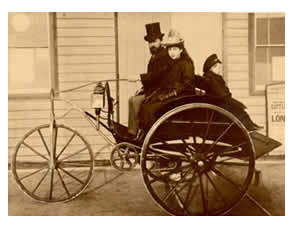
About 1880 he entered into a business partnership with fellow-countryman Fritz Hubel, along with several British backers who found the necessary capital to extend the scope of his experiments. A small electrical works were opened at Malden Crescent, Kentish Town, and the "Immisch Motor" was gradually evolved, and won medals at the Inventions Exhibition of 1885, the Antwerp International Exposition of the same year, and at various subsequent exhibitions. From thence to 1891 the firm seemed on the high road to success. The works were full of pioneer orders for dynamos and motors for use in running plant machinery for electric light, power transmission, pumping and hauling in mines, electric trams, electric launches, etc.
At this point it should be mentioned that Immisch's increasing reputation led to numerous people seeking his advice. Among those were Magnus Volk and the future Earl of Albermarle. Magnus Volk sought his views and advice over experiments to create an electric horseless carriage in 1887. (Earlier in 1883 Volk had received acclaim for building an electric railway along the sea front at Brighton). By contrast Viscount Bury, son and heir of the 7th Earl of Albemarle, contacted Immisch over experiments with electric trams and launches. (It is perhaps interesting to note: while Immisch, Hubel and Volk were originally from Germany, Viscount Bury's (Van Keppel) family were originally Dutch, arriving in England in 1688.)
Riker 1888-1899 - Riker Electric Motor Co. NY, NY
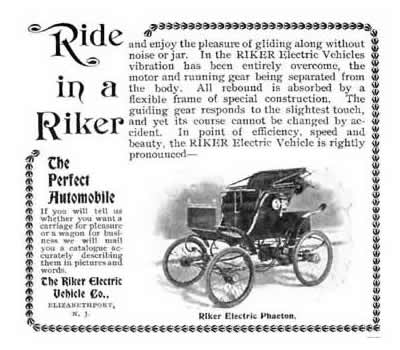
Andrew Lawrence Riker; (October 22nd 1868 to June 1st 1930). In 1884-86 Riker made his first electric, a modified Coventry bicycle, with a large outrigger wheel driven by a 1/6 hp motor of his own manufacture. It was said to go 8 mph.
Riker set up his business in 1888 making electric motors based on his patents. He invented the slotted armature and laminated field core designs. Between 1888 and 1890 he rigged two Remington bicycles together to create his four wheeled "motor cycle", it weighed 315 lbs.
His company made a full range of electric vehicles from 1895-1902, from a light two-seat tricycle up to a five-ton truck. In 1896 he raced one of his production cars running up to 27 mph. Riker got faster. On November 16, 1901 at Coney Island NY the 1,850 lb Riker racer, with a 60-cell battery under a platform with no body, went a mile in 60.3 seconds (59.97 mph).
The two motor Riker cars were made with a motor driving each rear wheel by means of a spur gear on the motor driving a ring gear on the wheel. While this is simple, efficient, and avoids the need for a differential, it means that the motors must be mounted in rigid alignment to the wheel.
This creates a lot of un-sprung weight, a liability on all but the smoothest roads. The gears were exposed to abrasive dust and pebbles that would gum up the works, affecting longevity and reliability. The Electric Vehicle Company purchased Riker for stock in December 1900 for Riker's patents. The Elizabethport plant was closed late in 1901. Riker, distracted by steam and explosion engines, and not a team player, left EVC January 1st 1902 to design cars for Locomobile. The Riker brand was used for Locomobile trucks in the late teens.
1896-1906 Lohner (Porsche)
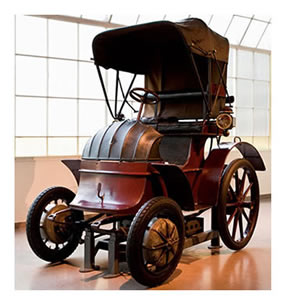
After a bad experience trying to mount a gas engine to a carriage, coachbuilder Lohner hired Bela Egger's firm to electrify it. The Egger motors kept burning out, so Lohner hired the companyís bright young electrical engineer, Ferdinand Porsche, to design a whole new car as a pure electric. The car featured hub-motors built into the drive wheels, most models had two drive wheels and one car had four. He soon redesigned the car as a hybrid for greater range. Mercedes (Daimler) sales representative Emil Jellinek bought five of the cars for resale in 1901, and later became an owner of the company. They were nice fast cars (on a smooth road) but a bit expensive.
1899: prototypes are built
1900: a front wheel drive Bat-Dash Stanhope was displayed at the Paris Expo.
1901: First production year, three open cars and an outside drive Brougham are offered. They also made one four wheel drive car and several hybrids.
1915 final production year
The company is thought to have made 272 electric vehicles and 7 hybrids; 153 passenger cars, 75 cabs, 67 fire engines, 29 buses, and 23 trolleybuses.
Also in 1900, Porsche designed the world's first functional hybrid car, the “Semper Vivus” (Latin for “always alive”). The technology, marketed as the Lohner-Porsche system, also had applications beyond the sphere of electric vehicles. Porsche extended the car’s range by not using a battery as an energy source, but instead using a combustion engine to drive a generator and thus supply the wheel hub with electrical energy. One year later, the production-ready version was born as the Lohner-Porsche “Mixte”.
Unfortunately the Lohner-Porsche also demonstrated why electric mobility has failed over the decades: despite its modest power output, the car weighed almost two tonnes. The lack of infrastructure and the short range put an end to electromobility for a long time.
The idea was resurrected more than 100 years later: With the development of lithium-ion batteries suitable for use in vehicles and ever more stringent legal requirements for pollutant and carbon dioxide emissions, the focus turned once more to electric drive systems. With the Cayenne S Hybrid in 2010, Porsche paved the way for electromobility in the company. As the first parallel full hybrid in the luxury car class, the Panamera S Hybrid was the most economical Porsche to date with a fuel consumption of 6.8 l/100 km (NEDC), despite a power output of 380 PS. Also in 2011, Porsche tested three all-electric Boxster E models.
1898-1915 Baker Motor Vehicle Co.
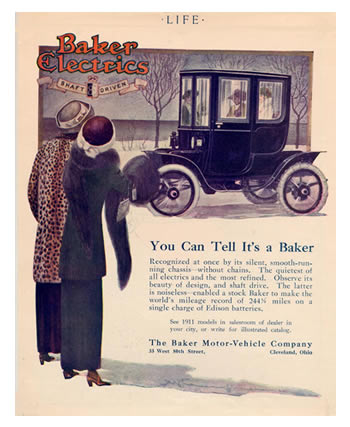
Founded by Walter C. Baker, (1868-1955) with Rollin White president, Fred White treasurer, and the Dorn brothers, Philip and Fredrick. Baker was one of the top motor vehicle innovators of the early era. Although best known for the electric cars that bear his name, and his early land speed records,
Baker came up with technologies and manufacturing processes that helped make all cars practical, such as modern ball bearings, steering knuckles, the fully floating rear axle with worm-gear shaft-drive (patented 1901), and vanadium alloy steel. Baker was with the Cleveland Screw Machine Co (a White Sewing Machine spin off) before starting the American Ball Bearing Co and the Baker Motor Vehicle Co in Cleveland. Walter Baker was also involved (from 1900) with the Peerless Motor car Co.
Baker bought Justus B Entz's patent for an electromagnetic starter/drive system from White in 1912, and licensed the rights to the R M Owen Co in 1913. This became the Owen Magnetic.
In 1897 Baker, with Fred Dorn, built his first electric, at Cleveland Screw. He was not working in a vacuum; Sperry was working on his cars there, and his friend C. E. Woods probably offered advice.
1899: Runabout, 2-passenger, 550 lbs with ten cells and a 3/4 HP motor. Chain drive to the rear axle, two speeds forward, one in reverse, and an advertised range of twenty miles. Edison bought the second one made.
1910: Four Models from $2,000-$2,600. The voltage was increased from 48 to 56. Baker claims sales of 1,000 cars. On August 30 1910 they ran a car for 201.6 miles on a single charge with a lead battery, later in the year they achieve 244-1/2 miles with an Edison battery. It is likely that at the end of the run the lead battery was scrap and the Edison battery was nearly normal.
1913: Three Models with Exide batteries, and six forward speeds. Wheel steering was optional.
Victoria; 2 passenger, 80" WB, $2,000.
Coupe; 4 passenger, 88" WB. $2,800.
Brougham; 5 passenger, 92" WB, $3,100.
1914: A Roadster with steering wheel replaces the Victoria $2,300.
1915: Baker is merged with Rauch & Lang, to settle R & L's patent infringements, with a capitol value of $2.5 Million. They merge the R. M. Owen Co. into the group in October with Raymond Owen becoming a vice president of Baker-R & L. Also in late 1915 GE became a major investor in the company pumping the capitol value to five million, they got three seats on the board.
1916: The Baker name is retired for passenger cars.
Woods Motor Vehicle Co. Chicago Illinois 1899
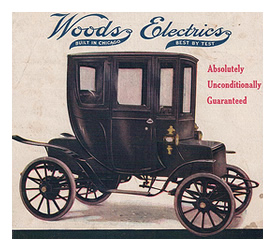
Clinton Edgar Woods wrote the first book on electric vehicles. This was Woods' second company, after American Electric.
He lost his equity position the second time when Samuel Insull (Commonwealth Edison), August Belmont (NY subway), and an investment syndicate with a number of Standard Oil investors, took over the unprofitable company for the purpose of challenging the Electric Vehicle Company's lead cab monopoly attempt.
The Woods Motor Vehicle Company was founded on the 28th of September 1899 with a capitalization of $10,000,000.
It was incorporated under the laws of New Jersey. It assumed the patents of the Fischer Equipment Company of Chicago and a factory at 110-120 East Twentieth St., Chicago with plans to upgrade another facility at 547 Wabash Avenue in Chicago for another factory. Frederick Nichols of Toronto, Canada, was installed as the first president and C.E. Woods was installed as one of the company's directors. Woods continued as consulting engineer.The Woods Company built their own motors. The bodies were made by the Fisher Equipment Co.(1899-1919 Fischer Equipment Company, 20th St, Chicago IL) Willard, with Sipe and Sigler, made the batteries. C Sinsabaugh estimated the company made 1,000 cars.
1901-1904 General Electric
The GE we all know was formed in 1892. Shoe manufacturer Charles Coffin put together a consortium to purchase the American Electric Co. from Elihu Thomson and Edwin Houston in 1883. He named the new company Thomson-Houston Electric. They then purchased Brush Manufacturing in 1889 and Sprague Electric Railway and Motor Co 1n 1900. In 1892 Coffin and Drexel-Morgan led Wall Street consolidators to make a near monopoly by merging with its main competitor the Edison General Electric Co, creating the General Electric Co. The management for the new company was all from Thomson-Houston, which, though smaller, was more profitable. Other then a few prototypes around 1900, including a series hybrid in 1902, GE did not make electric cars, though they made the components for many manufactures, and in late 1915 became a major investor (2.5 million) in Baker Rauch & Lang to produce the Owen Magnetic.
1905-1928 Rauch & Lang
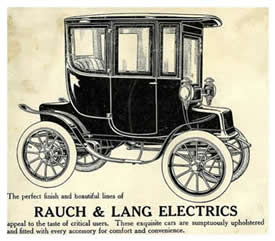
The Rauch family had been a builder of wagons, then luxury carriages, in Cleveland since 1853. Founder Jacob Rauch was killed in the Civel War at Gettysburg, his son Charles Rauch teamed up with accountant Charles E. J. Lang, whose family made a fortune in the Cleveland real estate boom, to build the business into the principal maker of wagons and carriages in the region. In 1904 they decided to make luxury electric carriages. The motor and controller were from the Hertner Electric Co, which became part of R & L in 1907.
The motor and controller were from the Hertner Electric Co, which became part of R & L in 1907.
In June of 1915, in part to settle infringements on Baker patents, R & L with a capitalization value of $1 million, merged with Baker, at a capitol value of $1.25 million, Owen Magnetic was folded into the mix along with fresh capitol from General Electric. The new company was called Baker Rauch & Lang, some of the Lang interests diverged as the Lang Body Co.
The new company was called Baker Rauch & Lang, some of the Lang interests diverged as the Lang Body Co.
In the winter of 1919-1920 the Company changed its name to Baker-Raulang with a body division and a material handling division (eventually absorbed by Otis Elevator). The automobile division was sold to Stevens-Duryea of Chicopee Falls Mass, they opened a subsidiary called Rauch & Lang Inc, which made electric cabs.
1912-1915 Flanders Pontiac MI.
A consolidation of the Grant & Wood Manufacturing Co, Pontiac Motorcycle Co, Pontiac Drop Forge Co, Pontiac Foundry Co, and the Vulcan Gear Works. Capitalized @ $2.5 million. Named after the company director and machine tool wizard Walter Flanders. Flanders set up the tooling and production line for the first Ford model T and was the "F" of E M F corp. E. Le Roy Pelletier rescued the Company in 1913 after Studebaker bought EMF. Before getting Walter's permission to use his name he briefly called the car a Tiffany. Walter Flanders went on to produce the Maxwell.
Fewer than 100 Flanders/Tiffany were made.
1911 A light low Coupe with worm drive. Marketed to the male driver. $1,775
1913 a 4 pass Victoria for $2,200 and a 5 pass Colonial for $2,500. 100" WB, in-house batteries. They had Timmerman motors and worm drive. Studebaker built the bodies.
Woods Motor Vehicle Co. Chicago Illinois 1899
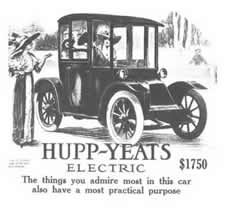
Robert Craig Hupp worked for Olds and Ford, in 1908 he founded Hupmobile with his younger brother Louis. As with his former employers, his idea of a car company was different then that of his financial backers, and he sold out in 1911 to found his own company.
The old company owned his name so the new car was called a Hupp-Yeats.
Better batteries were available and the new car was electric, featuring luxury coaches with a low hung body for ease of egress, lower center of gravity, and a more modern style. They used bevel shaft-drive and Westinghouse motors.
1911: 1-A Regent Coupe, four-passenger, 86" wheel base, 9" ground clearance, $1,750
1912: 1-A (as above), 2-A Torpedo Roadster, 1-B Patrician Coupe 100" WB, 2-B Patrician Torpedo Roadster 100" WB,
1913: 4-passenger Regent Coupe with an Exide battery for $1,750.
Is Electric the Option for Your Auto Needs?
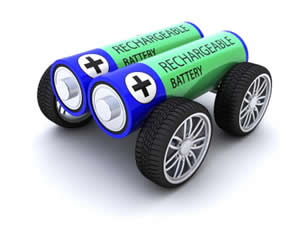 It is easy to say we are a society that is trying to go "green" and leave it at that. That beings said, are you doing your part? Do you think that you could decide between changing over your vehicle for example from gas to electric? There are a lot of good reasons to make this change. Switching from your air suspension truck that takes gas to do the job might seem like a hard mountain to climb, but it could be well worth the effort.
Electric cars have access to fuel more often than gas operated vehicles. Regardless of where you are, you are likely to be able to find a place to plug in if you really need to. In addition, thanks to technological advances these cars can go much farther then they once did before needing a recharge. You don't have to worry about losing your power in the middle of nowhere because they also often come with backup fuel storage for gas allowing you to have access to gas in a pinch. Not having to spend all your money on gas in order to get to and from work each day is certainly one advantage of using electric cars.
You may want to convert your current ride complete with air suspension to electric. This may be a little more costly and time consuming but it would certainly allow you to keep all things you love about your car while getting the best of electric fuel. Making the decision to change your vehicle to electric is a big one but, more and more resources are leaning to making this an easy option for anyone wanting to protect their environment and save money on the ever increasing expense of gasoline. Will you become electric in your future or stay with the gas option?
The X Factor – Electric Vehicles
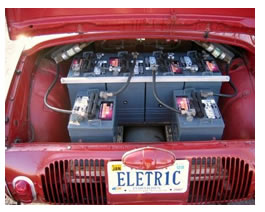 We keep questioning successes and failures of the big name EV automakers but neglect to realize that many of the stakeholders in most of these major EV companies are those who manufacture and supply the major components such as the energy storage systems, wiring systems, thermal systems, power electronics, electric motors and power train gearbox components. These stakeholders are amongst the most powerful and financially healthy companies in the world and have been designing electric and automotive related components for more than 100 years. If you don't believe me send me an email by clicking here and put on the subject line The X Factor – Electric Vehicles. I will send you the X Factor list.
Yes it's true that EV automakers are having a hard time developing the ultimate electric car that is appealing and able to perform at higher than normal speeds and with ranges of between 150 and 300 miles on one charge.
Yes it's true that EV automakers keep running out of money and needing more and more of it, in order to cover their labour and development costs.
Yes it’s true that promises to deliver vehicles are broken again and again.
Yes it’s true that you need to leave substantial deposits in order to reserve your dream Electric Car that hasn’t been manufactured yet.
The truth of the matter is that the only losers in this wonderful world of Electric Vehicles is the initial small primary investors and original inventors that have dedicated their entire lives and fortunes for the benefit of developing the ultimate EV for us diehard Electric Car Fanatics that want to go green and impress our friends and family members and make earth a cleaner place to live in.
Look the whole point of this article is to let you know that it’s not worth discussing which EV automaker will make it in the long run. They are all running in the same direction and in my view as the clock goes forward the Electric car will only get better through this trial and error period. For those who need an extended range electric car you can choose to purchase a plug-in hybrid like the Chevy Volt. For those that like an all electric you can go for one of the Tesla Models, the Coda Electric Sedan or the Nissan Leaf. For those that want small nifty commuter electric cars you can opt for a Wheego Electric Car or a Miles Electric. Soon you can even purchase an authentic original Detroit Electric Sedan. Apparently even India's Tata Technologies has unveiled a prototype at the Detroit Auto Show for 2012. Ford will also unveil their all electric version soon. The news of new releases keeps growing as the time goes forward. Toyota and Mitsubishi have also recently announced their EV releases for 2012. Even BMW is whispering about their version of the electric car for the future.
Just remember that a majority of the electric vehicle components come from all the major stakeholders as mentioned above. They will never lose because they will always supply the demand. The consumer will continue buying and complaining and the EV automakers will continue building better vehicles off the backs of the initial first time buyers. EV automakers will continue to make mistakes and the electric component suppliers will continue to supply their new and improved EV components. This is how the EV world works for now until the ultimate electric car is developed to meet the challenges that all electric car enthusiasts require.
Get used to it because it’s only the beginning. I love the Tesla Model X and the Coda Electric Sedan but my bet for 2012 is on the Nissan Leaf. I believe in Carlos Ghosn who is the driving force behind the e-car that runs Nissan and I truly believe they are ahead of the pack. Yes the Nissan Leaf is a proven true electric vehicle and I will be driving one very soon. I’m sure Nissan will easily back their warranty and also honour any needed upgrades and recalls in the future. I also feel that Nissan is not going away in the very near future. They are a healthy automaker with proven years of reliability and knowhow. I don’t believe they will discontinue making electric cars in the future especially after investing three times more in the Leaf then any of the other EV automakers. Nissan has put all their marbles in the same bag this time and it seems they’re planning to go all the way with this one.
In conclusion the whole EV Industry is owned by a pocket full of wealthy EV component manufacturers. They have been around more than a hundred years and the EV marketplace will get larger and larger every year. It’s a win win situation for everybody.
Don’t be afraid to purchase an Electric Car today. In fact test drive one and you will be sold. It doesn’t matter which one. They all come from the same EV component manufacturers. Even if you buy the wrong one it will become a collectable. Small EV garages will spring up and repair your defective Electric cars. You’ll be part of the EV community and participate in blogs and community events showing off your discontinued collectable electric car. Everyone wins on this one and becomes part of the EV Community.
We also have to give many thanks to the ATVM (Advance Technology Vehicles Manufacturing Loan Program) that has made available $25 billion to provide debt capital to the US automotive industry for the purpose of funding projects for vehicles manufactured in the US to meet higher mileage requirements and US dependence on foreign oil. Without this loan program most of the EV carmakers wouldn’t even exist today.
I only wish that we all stop defaming EV automakers and give them the time to develop this wonderful technology. If we encourage them and give them a chance they will build them better for all of us.
Nikola Tesla – The True Genius and Father of Electricity
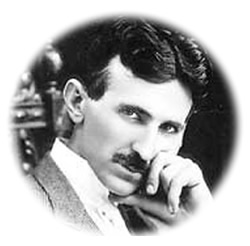 While researching this magnificent inventor I was touched and fascinated by his dedication to the field of electricity. Not only did he invent alternating electricity and the AC motor but registered as much as 500 US patents.
One of the greatest minds of the 19th and 20th centuries, responsible for today's modern world, Nikola Tesla is still virtually unknown to the general public. In fact who do you remember as the inventor of radio? The name that probably comes to mind is Guglielmo Marconi. X-rays, you'd probably say Wilhelm Conrad Röntgen. A vacuum tube amp, probably Lee De Forest. Who do you think invented the florescent bulb, neon lights, speedometer, auto ignition system, and the basics behind radar, the electron microscope, and the microwave oven? Chances are you see little, if any, mentions of Nikola Tesla. Very few people today have ever even heard of him. The all-around nice guy and business man Thomas Edison made sure of that.
In his late 30's in 1884 Tesla moved to the United States and worked as an assistant to Thomas Edison. Edison had just invented the electric light bulb, but he needed a system to distribute electricity to houses. He designed a DC (direct current) system, but never worked the way it was supposed to. Edison promised Tesla lots of money in bonuses if he could figure out the problems. Nikola Tesla took the challenge and ended up saving Edison thousands of dollars, which was millions of dollars by today's standards. Edison later refused to keep his promise and never paid those promised bonuses. Tesla quit not long after that broken promise and Edison spent the rest of his life discrediting Tesla. This is the main reason Nikola Tesla was never credited for his achievements.
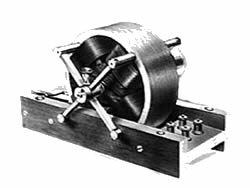 In 1888, Tesla devised a better system of transmission, the AC (alternating current) system used in houses around the world today. By using Tesla's newly developed transformers, AC could be stepped up and transmitted over long distances through thin wires. Edison's DC couldn't be stepped up, required a large power plant every square mile and thick cables for transmission.
Electricity is useless if it can't do anything, so in 1890 Tesla invented a motor to run on AC, the same type of motor used in every household appliance today. Scientists of the late 1880's were convinced that no motor could work with AC. Tesla solved this problem and proved them all wrong.
Word of AC eventually got to George Westinghouse. In 1893, Tesla signed a contract with Westinghouse to get $2.50 per Kilowatt of AC sold. Nikola Tesla finally had the money to conduct all of the experiments.
At the World's Fair, Tesla developed and used florescent bulbs in his lab 4 decades before the power industry "invented" them. Tesla took glass tubes and bent them into famous scientists' names and these became the first neon signs ever to be seen by the public.
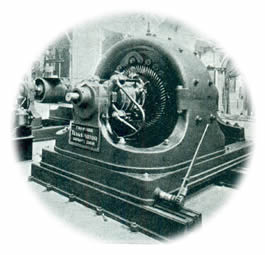 Tesla also designed the world's first hydroelectric plant at Niagara Falls in 1895 and started the electrification of the world. The first hydro-electric power plant in the world, Adam's Power Station is what remains of the old Niagara Falls Power Plant. This location is a great turning stone in the history of electricity. Adam's Station Power House is a National Landmark Historical Site. About eight million tourists a year visit the American side of Niagara Falls. About 20 million tourists a year visit the Canadian side. Niagara Falls is one of the most beautiful places in the world, where the electrification of the world started. Niagara Falls are the final victory of Tesla's Polyphase Alternating Current (AC) Electricity, which is today lights the entire globe.
By that time Edison had too much money invested into his DC system and he tried his best to discredit Tesla by showing that AC was more dangerous than DC. Edison paid local children 25 cents for each stray dog they could bring him. Then he would hold press conferences and electrocute the dogs at public gatherings to frighten people. He claimed that DC could not kill just to discredit the AC technology that Tesla invented.
Although Tesla made every attempt to clear his name and try to convince the public that his AC technology was far superior than DC technology the untrue and harsh propanda war against him was to powerful and overwhelming.
When working at Westinghouse he was owed a million dollars and settled for a fraction of the amount to avoid Westinghouse going bankrupt. Tesla could have become one of the richest men in the world but instead sold his patents for pennies just to survive. To think that his honesty and caring characteristics caused all his misfortunes.
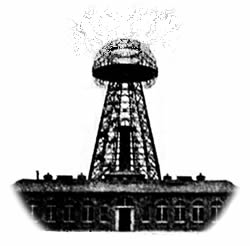 He was so intelligent and ahead of his time that he attempted to create free energy when he began construction of "Wireless Broadcasting System" tower on Long Island, New York. Tesla intended to use it to link the world's telephone and telegraph, to transmit pictures, stock reports, and weather information. When capitalists learned of this free wireless energy all funding was cut. Tesla ended up selling what was supposed to be the greatest gift to mankind for scrap to pay off creditors.
Edison did everything in his power to discredit Tesla. We've always lived in a society filled with greed. Everything Nikola Tesla lived for kept been taken away from him.
Still today there are untested theories found in countless notebooks written by Tesla.
Tesla was one of the world's most original and greatest inventors and thinkers the world has ever known, but because he was so original and out of his time, his genius was mistaken for insanity and science fiction.
The man who invented the modern world died nearly penniless at age 86. Tesla died quietly and alone in room #3327 on the 33rd floor of the Hotel New Yorker in New York City. I hope to write more articles about this great inventor and True Father of Electricity.
Please take the time to learn more about this phenomenal kind and honest inventor Nikola Tesla and pass it forward so others will learn the truth of the True Father and Inventor of Electricity..
The Future of Electric Vehicles for 2012 & beyond (Mario Fragapane)
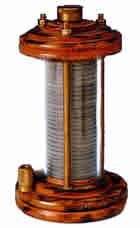 To think that the first source of continuous electric current was invented in 1775 by an Italian physicist called Alessandro Volta. He created a battery using zinc and cooper with weak acids between each layer. Then a Frenchmen called Gaston Plante invented a functional storage battery in 1865 and his fellow countrymen Camille Faure further improved the storage battery in 1881. Better capacity storage batteries were needed for electric vehicles to become practical and compete with gasoline-powered vehicles.
The same problems exists today 150 years later and guess what, better capacity storage batteries are still required to compete with now more advanced gasoline-powered vehicles and hybrids. It all comes down to long range capabilities and to have a simple solution to fill up economically and quickly. But I strongly believe that for short distances and for urban travel an electric vehicle is the right choice. In the near future the cost of owning an electric vehicle will be comparable to owning a gasoline-powered vehicle and eventually we will see more electric vehicles on the road. A perfect example of this is the popularity of the all electric Nissan Leaf and the all electric models for 2012 from Tesla Motors.
Azure Dynamics is also leading the way with their popular Ford Transit Connect All Electric Van that integrates its proven Force Drive™ electric power train into the award-winning Ford Transit Connect. Utilizing an advanced lithium-ion battery from Johnson Controls, the Transit Connect Electric can achieve a range of 50-80 miles depending on auxiliary usage and drive cycle, and has a top speed of 75 mph. The battery is rechargeable using either a 240-volt or standard 120-volt outlet.
This on going evolution has lead us to three of the most popular and viable types of batteries used today, namely Lead-acid batteries, Nickel metal hydride batteries and Lithium-ion batteries.
-
Lead-acid batteries – The most widely available and the least expensive, electric cars that use lead-acid batteries usually have a range of 80 miles per charge. There are concerns however, over their disposal. Lead-acid battery recycling is popular although an effective pollution control system is needed to reduce emissions. Although lead-acid batteries are the cheapest energy storage products in the world to manufacture, the extensive use of lead gives them an exceptionally large footprint and weight. Again, like other performance aspects of this industry’s products, this limits their form factors and overall utilization in new product designs. In addition, a traditional lead battery plate (there are over 100 of these in a typical automotive lead acid starting battery) on average only utilizes 30% to 40% of its surface area over the life of the battery. This creates even more inefficiencies of power-to-weight ratios. Not as reliable in cold weather. Lead-acid Batteries will provide 100 percent capacity at 27°C (80°F) will typically deliver only 50 percent at –18°C (0°F).
- Nickel metal hydride batteries – Abbreviated to ‘NiMH’ these have a higher energy density than lead-acid batteries and can deliver a range of up to 120 miles. The energy density for nickel metal hydride batteries is approximately 250kJ/kg and these batteries have been used in many all-electric plug-in vehicles including the Toyota RAV4 EV, General Motors EV1 and Honda EV Plus. They have also been used in hybrid vehicles including the Toyota Prius and the Honda Civic Hybrid. Generally they have a lower environmental impact than nickel-cadmium batteries due to the absence of the toxic cadmium. Most industrial nickel is also recycled due to its high value. Not reliable in cold weather.
- Lithium-ion batteries – Lithium-ion batteries are widely preferred for electric car use due to their superior range per charge – at around 250-300 miles. They are also less expensive than nickel and they have a low discharge rate of approximately five per cent per month compared to 30 per cent per month from nickel-metal hydride batteries. To prolong the life of a lithium-ion battery, it should be charged early and often, they should never be depleted below their minimum voltage and they should be kept cool but not frozen. The Nissan Leaf, Tesla Electric Roadster and the Sedan S use Lithium-ion Batteries. Other helpful tips for extending battery life include not subjecting the EV to high temperatures (over 120 ˚F) or low temperatures (below -13 ˚F) for an extended period of time. For the moment Lithium-ion technology is expensive and makes up a third of the cost of an electric vehicle. There is an ample supply of lithium but only a handful of suppliers. As the demand grows the price will eventually drop.
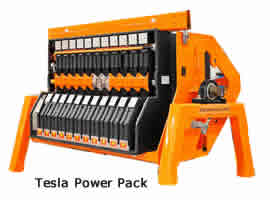 The battery pack in the Tesla Roadster uses Lithium-ion cell technology. Tesla's battery pack architecture enables world-class acceleration, safety, range, and reliability. The non-toxic pack is built at Tesla’s Headquarters in Northern California.
The pack weighs 990 pounds, stores 56 kWh of electric energy, and delivers up to 215 kW of electric power. Tesla battery packs have the highest energy density in the industry. To achieve this energy density, Tesla starts with thousands of best-in-class Lithium-ion cells and assembles them into a liquid-cooled battery pack, wrapped in a strong metal enclosure. The battery is optimized for performance, safety, longevity, and cost.
In general, Lithium-ion cells cannot be charged below 0 degrees Celsius, which would theoretically prevent charging in cold environments. To overcome this cold weather charging obstacle, the Roadster is designed with a heater to warm the cells (when plugged in) to an appropriate charging temperature. If there were no battery pack heater, drivers living in cold environments would have difficulty charging and experience stunted driving performance.
Likewise, the cells are designed to operate in high-temperature environments. High-performance driving is possible in even the hottest environments of the world. If the temperature rises above a set threshold, the air conditioning unit sends chilled coolant through the pack. Similar to the radiator fan of ICE-powered cars, the chilled coolant continues to circulate after the motor has been turned off to keep the temperature at an appropriate level. Cooling the pack enables a driver to quickly charge immediately after hard driving in hot climates. Without such a cooling system, recharging in hot weather would be delayed after each drive.
The wave of the future seams to be leaning towards ultracapacitors.
Ultracapacitors – also called supercapacitors – are more powerful cousins of the basic capacitor. With activated carbon at their core to act as a sponge for electrons, ultracapacitors can absorb power – or send a charge – far faster than batteries. They are also far more durable.
First used in the 1960s, ultracapacitors today are widely found in electronic devices such as computers. In cameras, they retract and expand zoom lens. Yet the power stored by today's ultracapacitors is still only about 5 percent as much as a modern lithium-ion battery, far too little to power a car by themselves. What is needed is a material known to retain vast amounts of power. Although EEstor a Texas based company claims that the solution is using barium titanate a material known to retain vast amounts of power. EEstor has made claims since 2007 that they are close to finding a solution but have yet to deliver their claims. EEStor's take on the ultracapacitor -- called the Electrical Energy Storage Unit, or EESU -- combines the best of both worlds. The advance is based on a barium-titanate insulator claimed to increase the specific energy of the unit far beyond that achievable with today's ultracapacitor technology. It is claimed that this new advance allows for a specific energy of about 280 watts per kilogram -- more than double that of the most advanced lithium-ion technology and a whopping ten times that of lead-acid batteries. This could translate into an electric vehicle capable of traveling up to 500 miles on a five minute charge, compared with current battery technology which offers an average 50-100 mile range on an overnight charge. As if that weren't enough, the company claims they will be able to mass-produce the units at a fraction the cost of traditional batteries.
Many major battery makers are also trying to design the ultimate ultracapacitor for the future taking in mind cost and reliability.
The leading manufacturers of ultracapacitors today are Maxwell Technologies in the United States, NESS Capacitor Company in South Korea, Okamura Laboratory in Japan, and EPCOS in Europe. These companies manufacture carbon-carbon, or symmetric, ultracapacitors. That is, both electrodes have identical construction. There are some differences in the organic salts and solvents used, and this is where ultracapacitor manufacturing becomes proprietary.
Honda Motor Company is using ultracapacitors in its FCX hybrid fuel cell vehicle, a few test models of which are already on the road in California. According to a spokesman for Honda, "Utilizing ultracapacitors, we have gained an edge in energy efficiency and throttle responsiveness over competitors that are pursuing the hybrid battery/fuel cell model."
Maxwell Technologies of San Diego announced that it has contracted to provide ultracapacitors for 27 hybrid gasoline-electric buses being built for Long Beach Transit of Long Beach, California. Beyond these already superlative ultracapacitors, yet another generation with 10 times more energy-storage capacity was recently announced.
Rechargeable Zinc-Air Batteries
The battery design is based on technology developed at SINTEF, a research institute in Trondheim, Norway. ReVolt was founded to bring it to market and so far has raised 24 million euros in investment. James McDougall, the company's CEO, says that the technology overcomes the main problem with zinc-air rechargeable batteries--that they typically stop working after relatively few charges. If the technology can be scaled up, zinc-air batteries could make electric vehicles more practical by lowering their costs and increasing their range. The zinc-air battery for hearing aids will be available next year. The battery for electric vehicles is still some years away from mass marketing.
Article by Mario Fragapane - Januarry 2012
Electric Cars or Not? (Mario Fragapane)
Finally there may be light at the end of the tunnel to replace and abolish polluting, fuel operated vehicles. With the release in 2011 of the electric battery driven Leaf Nissan that will be able to travel 160 kilometers between charges and the Volt by General Motors that is able to travel 60 kilometers with a rechargeable battery and also having the ability to run up to 500 kilometers with an assisted small gasoline engine, this could mean that the future looks cleaner than we think.
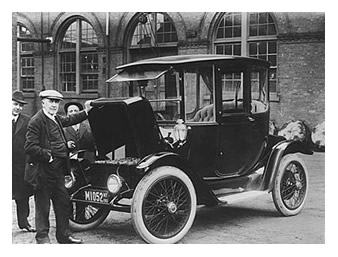
In the early 1900's there were a many electric cars produced by Baker Electric (1899), Detroit Electric (1907), Edison Electric (1889), Studebaker (1907) and in the periiod were out selling gasoline vehicles. The only disadvantage was there speed limitations of 20 miles per hour.
With the introduction of the electric starter in 1913 by Cadillac that made it easier to start a internal combustion engine and the introduction of the affordable Model T Ford that was introduced in 1908, this ultimately killed the electric car in that era.
Could there be a come back to the electric car. It's hard to believe especially after what happened to the EV1 Electric Car that GM surprisingly put to an end in 1996. In the same period we saw the Toyota RAV4 Electric Vehicle that was also terminated. The Ford Ranger EV pickup truck that was terminated. The Nissan lithium-battery Altra EV mini wagon that was terminated and yes the Chrysler TEVan that also mysteriously disappeared.
Automakers refused to properly promote or sell their EVs, allowed consumers to drive them only by closed-end lease and, along with oil groups, fought the mandate.
After public protests by EV drivers' groups upset by the repossession of their EVs, Toyota offered the last 328 RAV4-EVs for sale to the general public during six months (ending on November 22, 2002). All other electric cars, with minor exceptions, were withdrawn from the market and destroyed by their manufacturers. To its credit, Toyota not only supports the 328 Toyota RAV4-EV in the hands of the general public, still all running at this date, but also supports hundreds in fleet usage. From time to time, Toyota RAV4-EVs come up for sale on the used market and command prices sometimes over 60 thousand dollars. These are highly prized by solar homeowners, who charge their cars from their solar electric rooftop systems.
If enough of us are fortunate enough to read this article then maybe we can get more passionate about Electric Driven Vehicles and fall in love with the fact that they are fascinating vehicles to drive and will promote a green environment and possibly a future for our children.We urgently need to reduce our greenhouse gas emissions and bring the planet's climate back to a normal pattern...
We have all heard the claim that green house gases is partly generated by human activity, such as driving automobiles which in turn causes global warming. Why argue against this claim? Activists have lobbied congress to regulate the automobile industry to create more efficient cars. Is this a wise approach? Is it the best approach? A little simple mathematical thinking can take us a long way in evaluating this problem.
It doesn't take much to see that for every person driving, there is more fuel being consumed and more gases being emitted. So for everyone who needs to drive, or chooses to drive, more greenhouse gases will be produced.
The obvious implication is that an increasing population results in increasing greenhouse gas production. Similarly, increased dependency on technology results in increased greenhouse gases, even while engines become more efficient. If the number of drivers doubles, the fuel efficiency must also double, just to keep the emissions at the same level.
Conclusions: The rising population and dependency on technology are major factors in greenhouse gases.
Greenhouse gas concentrations are already close to dangerous levels for further warming and climate chaos in all parts of the world.
Mother Nature is telling us to stop destroying the planet and start changing our habits. I hope this site makes you realize that we can help prevent further damage by at least considering Electric On Wheels or a hybrid vehicle
So lead the way and think electric. Together we can make a difference.
Article by Mario Fragapane - Januarry 2012
What ever happened to the EV1 electric car by GM?
What ever happened to EVI Electric car by General Motors and all the other Electric cars made in the past by the major automakers such as the Hypermini by Nissan and The RAV 4 Electric by Toyota?
This is a video about the EV1
This article isn't meant to pursuade you to purchase an electric car but to make you aware of the power petroleum companies have around the world.
 Aren't you fed up of air pollution and all the television and radio advisories concerning smog and high levels of pollution in your area.
Well oddly enough we did have solutions awhile ago. This is going back in 1996 when General Motors started introducing the EVI Electric Cars in California - USA.
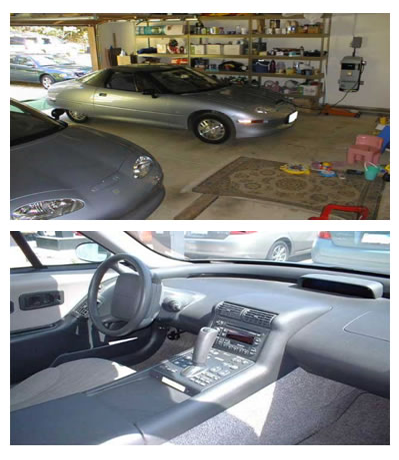
Not bad looking for a car made in 1996.Came in a variety of colors an used by happy Californians daily on California roads and highways.
You were able to lease an EVI for three years.
When very happy and satisfied customers when back to renew or exercise purchasing their leased units the GM dealership said absolutely no and took back the vehicles from the customers.
In fact there was no buy back option available on the lease agreement.
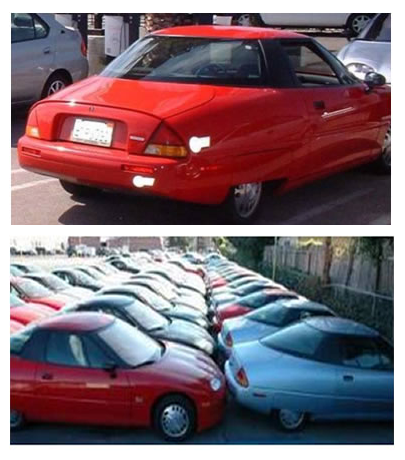 Although there was opposition by the lease holders of the EVI Electric Cars it wasn't enough to convince GM and the EVI cars were simply returned and never to be seen again.
Ten years later the cars are gone and have disappeared.
Dismantled, crushed and recycled to make gas operated cars again.
What irony for such a wonderful invention that worked well, was economical, easy to maintain and simple to operate.
In the garage the image demonstrates the way the owners of the EVI Electric car would use an apparatus on the wall that came with the vehicle when it was leased at the GM dealership.
Simply park the vehicle in the garage after use and plug it in so it could be used the next day.
You can't get greener than that.
Nissan Hypermini - 1997
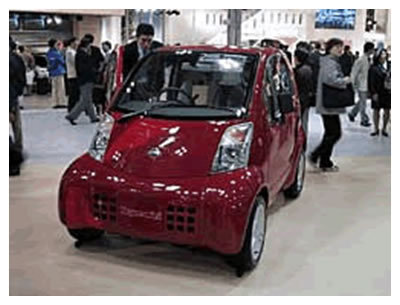 In 1997 Nissan launches the Hypermini electric car series at the Tokyo auto salon.
The city of Pasadena in California adopts the cars for their municipal employees mainly for their ease of parking and manuouverablilty and of coarse the environmentally friendly feature as an electric car and the economy it offered to the bottom line,
In August of 2006 the same experience occurs as the EVI Electric. The leases expire, the cars are returned and sent to the scrap yard to be crushed and forgotten again.
Toyota Rav 4 Electric - 2003
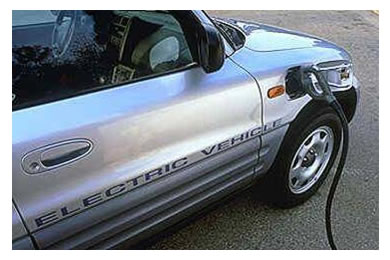 In 2003 Toyota decides to stop the production of the RAV 4 Electric series. This was excellence in EVI vehicle technology.
When the lease were at term in 2005 the same fate was awaiting the lease holders. Toyota attempted to retrieve the vehicles and destroy them in the same way GM and Nissan had done. But this time there was a large organization that took over the decision making for Toyota. An organization called Don't Crush was formed and pressured Toyota for three months and was finally victorious over the decision and spared the vehicles.
Press Launch on the EV1 on release day
Read the press release launch content text GM used on the EVI car release day:
On January 4 in Los Angeles, General Motors made two big announcement. First, they unveiled the automobile that will carry America into a new era of driving - EVI, the electric car. The first from the ground up, built from scratch, true electric car. And the first electric passenger vehicle ever to be brought to market by a major automaker.
GM then announced that they have selected the ideal company to launch EVI. A company with the people, philosophy, and now-how to propel the electric car on the road to success --Saturn. (We must admit, we're all pretty darn excited about the opportunity. Not to mention the compliment.)
So starting this fall, Saturn retailers in Southern California and Arizona will be the first in the country to display and market EVI.
Here are just a few remarkable EVI facts:
- Accelerates from 0 to 60 in less than 9 seconds
- Maximum speed of 80 mph (electronically regulated
- Prototype set land-speed record for electric cars: 183 mph
- 137 horsepower, three-phase AC induction motor
- 0.19 drag coefficient -- 30% less than any production car
- Driving range: 70 miles city, 90 miles highway
- 3-hour charge time using 220-volt, 6.6 kW charger
- Regenerative brakes that help charge the batteries
- World's lightest and stiffest spaceframe for any vehicle its size
if there are other related articles that could be added to this article please let me know and I will add the changes.
The true story of the EVI from GM (reference - ev1.org)
GM only leased the EV1 under special conditions that removed the purchase option. If you didn't sign the lease, you didn't get the car: as one Honda Honcho stated, "...they don't care whether you take it or not, they are losing money on each one...".
In 1997, GM released the first of two "builds" totaling about 650 1997 EV1. Originally powered by Delco (now Delphi) lead-acid batteries, they only had a 60-70 mile range and the battery packs often proved defective. After 1998, the defective Delco packs were gradually "upgraded" to Panasonic lead-acid batteries, which increased the range to 110 miles and never failed. While peppy, there was an alarming sway under heavy acceleration, the windshield seals leaked into the dashboard electronics, and the windshield tensioning led to persistent windshield blowouts. These leases had "unlimited miles", but that didn't do much good since the cheap Delco batteries kept breaking down.
On Mar. 2, 2000, GM issued a "voluntary recall" of ALL 1997 EV1, claiming that the 1997 EV1 had design flaws, one of which could lead to fires under certain conditions. This was an underbuilt Magnecharger input port, which needed an upgrade that affected all the charging electronics. After 14 months, GM re-released the "upgraded" 1997 EV1 back to their original lessees, this time under modified two-year leases that did not include unlimited mileage. All the "non-upgraded" EV1 were destroyed, and crushed. Just when the EV1 really could travel 200 miles per day with the new Panasonic batteries, this change now billed extra miles at 35 cents per mile.
All of these 1997 EV1 found lessees; none was unclaimed. Those EV1 drivers who lost their "non-upgraded" EV1 were put at the top of the list for getting a 1999 Nickel Metal Hydride ("NiMH", EPA-certified 140-mile-range) model, when and if they were ever released.
GM hinted that they were unable to produce the EV1 with NiMH batteries, which is the reason they released it originally in 1997 with lead-acid batteries. The Impact prototype was crammed with lead-acid batteries in a battery "T" shaped tunnel, which was difficult to ventilate. Putting NiMH batteries into this tunnel was a design disaster. What was needed was a redesign, putting the NiMH batteries under the EV (as Honda and Toyota had done). Unwilling to change from the original design, GM just added a cooling system that used up a lot of energy.
Putting the lie to the claim that NiMH was not usable, Toyota designed and released a ZEV version of its then-new 1996-99 RAV4 which used NiMH batteries, and Honda released a version of its CRX called the Honda EV Plus which also used NiMH batteries. By starting with existing gasoline-powered vehicles, design and production costs were minimized; also, a simpler permanent magnet brushless motor was used, and, most importantly, the NiMH batteries were deployed in a tray under the floorboard. This aided cooling, and also, it turned out, was beneficial for the weights-and-balance and strength analyses. No such EV ever turned over, and the battery pack provided a natural "crush zone" in collisions.
These Japanese EVs were the first production EVs with range over 120 miles on a charge, thanks to the more powerful, longer-lasting, and more reliable NiMH batteries. Toyota, recognizing the importance of batteries, had formed an alliance with Matsushita (Panasonic) called "PEVE", which developed the EV-95 NiMH battery, the most-researched, most-powerful, most-tested, and the only successful battery that lasts longer than the life of the vehicle, perhaps over 200,000 miles. CARB recognized this in a 2000 position paper resulting from the Battery Technology Assessment Workshop that put an upper cap on NiMH costs at $350/kWh, or at most $12,000 for a typical 30 kWh 770 lb. NiMH battery pack. This amortizes out to no more than 6 cents per mile, less if the 90 lbs. of Nickel metal is recovered when the batteries are scrapped.
This might have been intended as a mild slap in the face of GM, which had gotten them into this trouble in the first place. Essentially, Honda and Toyota were faithfully trying to fulfill the letter of the ZEV mandate, which might have embarrassed GM if it were capable of embarrassment.
To add insult to injury for GM, the Honda and Toyota offerings were issued for $499/month, less money than the $599 lease cost of the EV1, which had less powerful, defective batteries. GM was forced to lower its lease cost.
The 1999 EV1 was delayed, GM stated, by a cooling issue. The original EV1 was designed for lead-acid batteries, which were more heat-resistant than the much more powerful Nickel Metal Hydrid batteries used in the 1990 Impact.
Finally, in Dec., 1999, under pressure from CARB's Jan. 1, 2000 deadline, GM released about 200 1999 EV1 with NiMH batteries. They proved to have a 160 mile range, and never failed. In addition, GM solved some of the flaws in the 1997 version, removing the sway, new seals, etc.
As one EV1 driver happily exclaimed, "...Its a sensation...Huge congratulations ... A revolution in ... range..."
All the 465 1999 NiMH EV1 which were made available found happy lessees. None ever went unwanted, none ever had problems. All were mourned when they were abruptly crushed by GM.
No more were ever built after 1998. GM had dismantled the EV1 supplier and manufacturing plant in 1998, it was reported by GM insiders; the only question was who would be allowed to lease the already-built EV1. Over the next 18 months, the remaining 200-odd 1999 EV1 were released, a few at a time, to selected lessees, mostly high-profile celebrities and politicians.
- There was never a time when an EV1 could not find a willing lessee.
- In 1999, ex-Governor Davis appointed Alan Lloyd, a fuel cell advocate and enemy of Battery EVs ("BEV"), to the position of Chair of CARB. CARB gradually weakened and then withdrew the BEV component of the ZEV mandate (it was existing EVs that were killed: the ZEV mandate itself is nominally still in force, but currently "inoperative" so far as actually doing anything).
- With the 2000 seizure of power by oil politicians and the ascension of Andy Card, GM's chief lobbyist against ZEV Mandate, federal EPA policies were modified and CARB's ability to affect AAM policy and production diminished. At meetings, AAM execs just stood with arms folded, refuseniks.
- In March and April 2003, CARB Chair Alan Lloyd presided over postponing the ZEV mandate to 2018, "back-ending" compliance and relying upon Hydrogen Fuel Cell cars which would be much more expensive and would require extensive research over 15 years.
- No one can explain why Lloyd considered BEV "too expensive" but why the proposed 15 years of research into a new infrastructure and technology, less promising than Compressed Natural Gas, would be "practical".
- The batteries exist, the cars existed: the failure was CARB.